

Functional Vision Exam
Visual Skills and Functional Vision
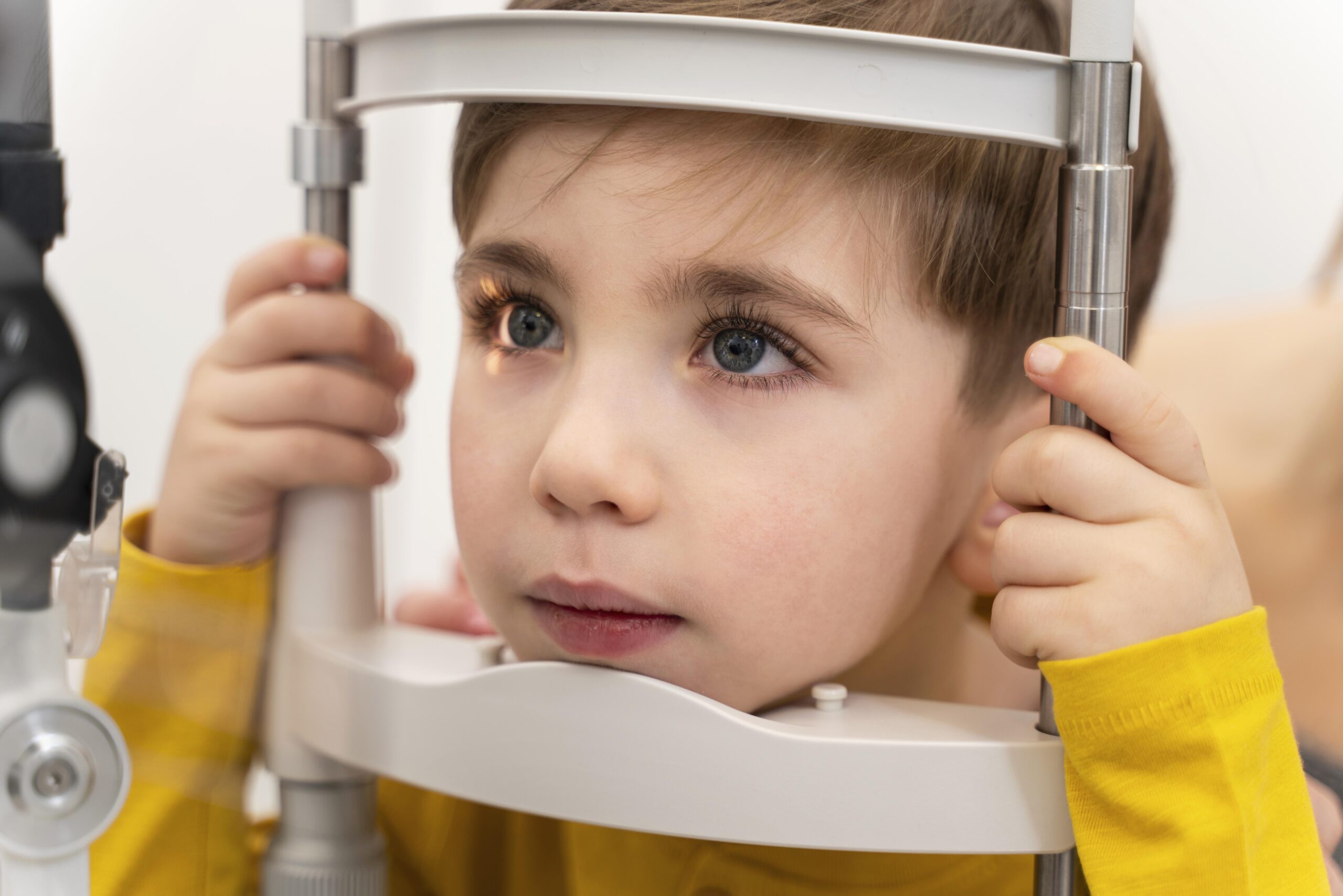
A Functional Vision Exam is the most effective way to assess how well your eyes and visual system work together. Unlike a routine eye test, a functional eye exam evaluates eye tracking, focusing, coordination, central vision, fusion vision, and visual processing to ensure comfortable and efficient vision for reading, learning, driving, and everyday activities.
At Nandadeep Eye Hospital, we offer comprehensive functional vision testing to assess visual skills and functional vision using advanced diagnostic technology. A functional vision test is recommended for children and adults experiencing headaches, eye strain, blurred or double vision, reading difficulties, or poor concentration. We also recommend a comprehensive eye examination for infants at six months of age, followed by regular eye check-ups to support healthy visual development and detect vision problems early.
What is Functional Vision?
Functional vision refers to how the brain, eyes, and visual pathways work together to help individuals interact effectively with their surroundings. The key aspects of functional vision include the following:
1. Binocularity/Vergence
- This skill involves both eyes aligning to focus on the same point, ensuring they work in a coordinated and precise manner. Proper eye teaming enables clear, comfortable, and efficient depth perception.
- If the eyes do not align correctly, the brain struggles to merge images from each eye, leading to double vision (diplopia) and loss of 3D depth perception. Poor eye coordination can also cause eye strain and fatigue.
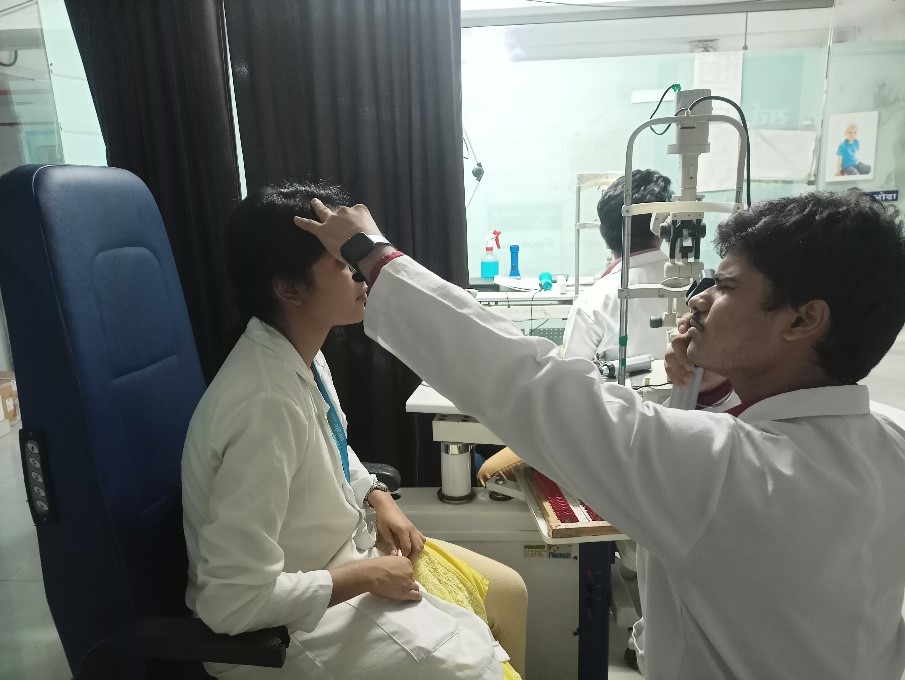
2. Eye Focusing/Accommodation
- This refers to the ability to see objects clearly and shift focus between different distances.
- For instance, a person might struggle to maintain clear vision while reading, experiencing intermittent or constant blurriness. Similarly, a student may see a book clearly but find it difficult to refocus on a distant whiteboard and back again.
3. Eye Movement (Ocular Motility) – Saccades and Pursuits
- This involves the eye’s ability to track moving objects, shift focus between different objects, and maintain fixation on a stationary target.
- Activities like following a moving ball, watching a butterfly in flight, or smoothly reading across a line of text require efficient eye movements. Maintaining eye contact while conversing is an example of sustained fixation on a still object.
Assessing Visual Processing
To gain a complete understanding of a patient’s vision, standardized tests evaluate various aspects of visual processing. Since vision is a learned skill, these areas can be improved through vision therapy. The following skills may be assessed:
Visualization
Visualization
The ability to create mental images and manipulate details. Essential for reading comprehension and mathematics.
Visual-Motor Integration
Visual-Motor Integration
Evaluates coordination between vision and movement. Important for handwriting accuracy and sports-related hand-eye coordination.
Visual Sequential Memory
Visual Sequential Memory
The ability to recall objects or words in the correct order. Deficiencies may lead to misreading similar-looking words like ‘saw’ and ‘was.’
Visual Discrimination
Visual Discrimination
The skill of distinguishing between similar shapes, objects, or words, such as ‘horse’ and ‘house.’
Visual Closure
Visual Closure
The ability to recognize an object or word with partial information. Critical for reading fluency and mathematical problem-solving.
Spatial Relations
Spatial Relations
Understanding the position of objects in relation to each other and oneself. Essential for problem-solving, advanced mathematics, and proper word spacing in writing.
Spatial Orientation
Spatial Orientation
Recognizing the correct direction of objects. Deficits may lead to letter and number reversals (e.g., ‘b’ vs. ‘d’ or ‘6’ vs. ‘9’).
Laterality
Laterality
Awareness of left and right concerning oneself and in space.
Directionality
Directionality
Understanding the proper orientation of letters and numbers.
Developmental Approach to Vision Therapy
At Nandadeep Eye Hospital, we adopt a developmental approach to vision therapy, ensuring the patient’s vision matures at all levels. To support this, we assess primitive reflexes that developed in utero and early postnatal stages, which might still interfere with visual development. If these reflexes remain active, targeted movement exercises help integrate them, improving cognitive and motor functions.
We evaluate the following primitive reflexes:
- Moro Reflex: Also known as the startle reflex.
- Tonic Labyrinthine Reflex: Helps with head-righting functions.
- Spinal Gallant Reflex: If retained, it may cause fidgeting and bedwetting.
- Asymmetric Tonic Neck Reflex: Supports crawling and cross-body movement.
- Symmetric Tonic Neck Reflex: Assists in visual adjustments from near to far.
- Palmar Reflex: If retained, it can contribute to difficulties with handwriting and speech delays.

At Nandadeep Eye Hospital, our goal is to provide a structured and individualized approach to vision care, ensuring each patient receives the necessary support to enhance their visual and cognitive development.
Meet Our Specialists Book your consultation with eye specialist
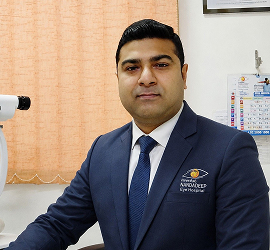
Optom Sayan Mukherjee
B.Optom., M. Optom. Consultant Optometrist, Vision Therapy, Speciality Contact lens